
Purpose
Our HSPAL program is dedicated to developing future leaders through a robust clinical and administrative curriculum. We value hands-on, patient-centered, and relationship-focused experiences that can be tailored to each resident’s professional interests. Our HSPAL program transforms residents into leaders who will drive the future of health care.
Description
The HSPAL two-year residency program at University of Utah Health develops clinically strong practitioners who are well positioned to specialize in pharmacy administration roles and become leaders in healthcare. The first year (PGY1) provides a strong practice foundation with emphasis on clinical skill development. The second year (PGY2) provides comprehensive experience in the management of pharmacy services in an academic medical center, including inpatient and outpatient settings. During the second year the resident will gain foundational skills in human resources, leadership, finances, automation and informatics, clinical and operational management, finance, compliance, supply chain, and medication safety. In addition, the residents will be concurrently enrolled in the Master of Healthcare Administration (MHA) online program through the University of Utah David Eccles School of Business. The MHA program provides an academic background to support and enhance the residency experience. Graduates of the HSPAL residency program will be capable of assuming roles as clinical coordinators, team leaders, and pharmacy supervisors or managers in a variety of pharmacy practice and healthcare settings. The HSPAL graduates have the training and skillset to become executive pharmacy and healthcare leaders.
Pharmacy Leaders
The University of Utah has a robust pharmacy presence across the health-system. Our pharmacy department is supported by a strong leadership team that includes our chief pharmacy officer, associate chiefs, directors, and over 50 managers and supervisors who oversee both operational and clinical management across a wide range of practice areas. These areas include inpatient pharmacy, specialty pharmacy, retail pharmacy, ambulatory care, infusion, and support services. Together, this leadership team plays a critical role in supporting our frontline pharmacists, staff, and technicians, ensuring high-quality patient care, streamlined workflows, and the continuous advancement of pharmacy practice throughout the organization. HSPAL residents in our program will rotate throughout the health-system to work alongside our various pharmacy leaders to gain hands-on experience.
Overview of Residency Structure and Requirements
Master of Healthcare Administration Online
Fall
Spring
Summer
Fall
Spring
PGY1
PGY2
Orientation
Required Rotations (8 total, 4-5 week duration)
- Management
- Drug Information
- Acute Care (2 rotations, 1 must be internal medicine)
- Critical Care Selective
- Transitions of Care Selective
- Antimicrobial Stewardship OR Central Operations
- Ambulatory Care Selective OR Capstone
Required Rotations (3-5 weeks, specific duration defined in PharmAcademic Learning Experience Description)
- Orientation (2 weeks)
- Medication Safety & Quality
- Clinical Management Selective
- University Hospital
- Huntsman Cancer Hospital
- Ambulatory Selective
- Ambulatory Clinical Care
- Infusion Services
- Retail Management
- Specialty Pharmacy Operations
- Pharmacy Finance Basics
- Operations
- Supply Chain
- Informatics
- Retail Management
- Executive Leadership
Elective Rotations (1 rotation, 4-5 weeks)
See PGY1 Acute Care Rotations for further rotation descriptions and selective/elective options.
Elective Rotations (2 required, 4 weeks each)
- Investigational Drug Services
- 340B Program Management
- Drug Diversion and Analytics
- Automation
- Advanced Elective Rotation in Previous Required Rotation
Other elective learning experiences may be developed based on resident interest and preceptor availability.
Staffing: 48 shifts/year
- Inpatient Decentralized (every 3rd weekend)
- Central Pharmacy (1-2 shifts a month in the second half of the year)
- 1 major and 2 minor holidays
Longitudinal Required Rotations
- Pharmacy Finance & Budget (21 weeks)
- Longitudinal Management (52 weeks)
- Research Project (52 weeks)
- Health System Leadership and Pharmacy Strategy (26 weeks)
- Staffing
- Discharge (1-in-4 weekends)
- Central Pharmacy (~2 days per month including 1 major and 2 minor holidays)
- Pharmacy Administrator on Call (4 weeks)
Required Presentations
- Statistics-based presentation during Drug Information rotation
- Two recitation sections for the College of Pharmacy in addition to two other teaching or training activities such as lectures or workshops
- ACPE accredited CE presentation
- Poster presentation at Vizient® Pharmacy Network Meeting or ASHP Midyear
- Platform presentation of longitudinal project findings at Mountain States Conference
Required Presentations
- ACPE accredited CE presentation
- Poster presentation at Vizient® Pharmacy Network Meeting or ASHP Midyear
- Platform presentation of longitudinal project findings at Mountain States Conference
- Formal pharmacy department presentation
Other Required Activities
- Monday Meetings
Other Required Activities
- Coordinate 2 events for the department
MHA Online
The MHA online program is an asynchronous two-year master's degree offered through the University of Utah David Eccles School of Business. The courses are specific to healthcare administration including but not limited to management, economics, finance, operation, and quality. The courses are taught by instructors with extensive experience in the healthcare industry. Residents will complete the program alongside other professionals from various career backgrounds.
- Credit Hours: 43.5
- Program Length: Two years (5 semesters)
- Format: Online courses with optional weekly live webinars
PGY2 Required and Elective Rotations
Required
Medication Safety & Quality
Residents participate in safety event review, safety committees, and engage in quality improvement efforts to create a safer health-system.
Clinical Management (At University Hospital or Huntsman Cancer Hospital)
Residents rotate with a clinical pharmacist manager, leading teams of decentralized inpatient pharmacists in the development of new or enhanced clinical services.
Infusion Pharmacy Service Line
Residents experience the unique complexities of managing a successful outpatient infusion service, including USP <797> and <800> compliance, clean room design, and financial strategy.
Specialty Pharmacy Operations
Residents spend time with the PAC3 team learning about coordination of prior authorizations, access to specialty medications, and specialty accreditation requirements.
Ambulatory Care Clinical Management (Primary Care)
Residents work alongside the manager to standardize pharmacist workflows, improve documentation, and oversee quality improvement initiatives within ambulatory clinics. Additionally, the resident will generate ideas for new revenue streams, while optimizing existing revenue collection.
Pharmacy Finance and Budget
Residents learn about the budget cycle by participating in the planning, development, presentation, and assessment of department budgets. Additionally, residents will learn about the dynamic relationship between finances, strategic planning, and organizational goals.
Inpatient Operations
Residents acquire foundational skills in medication order verification and medication distribution through working alongside pharmacists and technicians in the central pharmacy. Residents will also be introduced to sterile compounding operations and medication safety concepts.
Supply Chain
Residents develop an understanding of drug procurement, inventory management, system distribution management, and the associated regulatory and compliance standards. Residents will also engage in vendor relations through interacting with the group purchasing organization and wholesaler and participating in the contracting process.
Informatics
Residents gain an understanding of basic informatics principles and best practices and how they relate to assessing, analyzing, and implementing clinical decision support, enhancements, incidents, medication shortage configuration, and quality improvement initiatives.
Retail Management
Residents learn the complexities of managing a retail pharmacy, including personnel management, workflow/production optimization, and financial management. Human resources issues are a focus in this rotation, including hiring, onboarding, and disciplinary action.
Executive Leadership
Residents spend time with the Chief Pharmacy Officer, Associate Chief Pharmacy Officers, and the Chief Operating Officer to learn about pharmacy’s role in system wide efforts to meet the patient care needs of the Salt Lake valley.
Capstone
This rotation is typically scheduled at the end of PGY2 year and is designed around the resident’s interests. Most residents accept a position for post residency and then use the capstone to prepare and address gaps in their knowledge/experience before they start their next job.
Electives
Investigational Drug Services (IDS)
The IDS team at the University of Utah manages over 450 clinical trials. Residents will work with the manager to provide drug accountability (drug storage, handling, dispensing, and documentation of administration, return and/or destruction of the drug) to promote maximum benefit and safety for those participating in each study.
340B
University of Utah is a participant in the 340B Program. During this remote rotation residents will work with the manager to learn about 340B compliance, oversight, operations, contract pharmacy, and audits.
Additional Information About Our PGY2
Department Events
The PGY2 residents will work together to coordinate at least two department events throughout the year. Events vary depending on the department’s need but typically include the biannual controlled substance count and the pharmacy department flu clinics.
Longitudinal Management
PGY2 residents will serve as the managers for the pharmacy intern program. Each resident will be responsible for two classes of interns (approximately 8-10 interns per class) and will facilitate their hiring and onboarding, make their schedule, attend monthly meetings, conduct evaluations, and conduct various professional development activities.
Pharmacy Administrator On Call
After completing two shadow weeks, PGY2 residents will join the rotation of managers and supervisors responsible for responding to pharmacy administration pages. Residents will be responsible for the pager for approximately four weeks (4 x 1 week duration) throughout the year. Residents can take a comp day after their week of admin on call or count the week as one shift toward their 48 shift staffing requirement.
Optional Activities
Residents can complete a variety of optional activities during their first or second year such as:
- ASHP Teaching Certificate
- Attending and presenting a poster at ASHP Leaders (ability varies depending on the budget each year)
- Lecturing at the College of Pharmacy
Other activities may be developed based on resident interest and preceptor availability.
Recruitment and Selection
All residency programs at University of Utah Health use the Pharmacy Online Residency Centralized Application Service (PhORCAS). No paper applications will be accepted. The following information must be submitted by the date specified on the residency application for the applicant to be considered for an interview:
- Completed PhORCAS application
- Curriculum vitae
- Letter of intent
- College of pharmacy transcripts
- Three letters of recommendation using the PhORCAS standard form with at least 1 letter from a clinical preceptor
Completed applications in PhORCAS are reviewed, and competitive applicants will be invited to participate in a virtual interview. The program participates in the ASHP Resident Matching Program.

Program Director
Ashley Bowden, PharmD, MS, BCPS
Pharmacy Operations Director
Ashley.Bowden@hsc.utah.edu
Bio
Ashley Bowden serves as the HSPAL Residency Program Director and Pharmacy Operations Director at University of Utah Health in Salt Lake City, Utah. She earned her Doctor of Pharmacy degree from The Ohio State University in 2015 and completed her Master of Science in Health System Pharmacy Administration at the University of Utah in 2017. She also completed her PGY1 Pharmacy Practice and PGY2 Health-System Pharmacy Administration residencies at University of Utah Health.
In her current role, she oversees investigational drug services, medication distribution for over 700 inpatient beds, central fulfillment of medication orders for over 400 university clinics, and the operations of four operating room pharmacy satellites. She is passionate about leveraging automation to enhance safety and streamline medication distribution processes. She is also deeply committed to mentoring and developing pharmacy interns and residents, helping them grow and advance in their careers.
Outside of work, Ashley enjoys spending time outdoors hiking or playing sports, and during the colder months, she can often be found attending theatre performances throughout the Salt Lake.
Program Coordinator
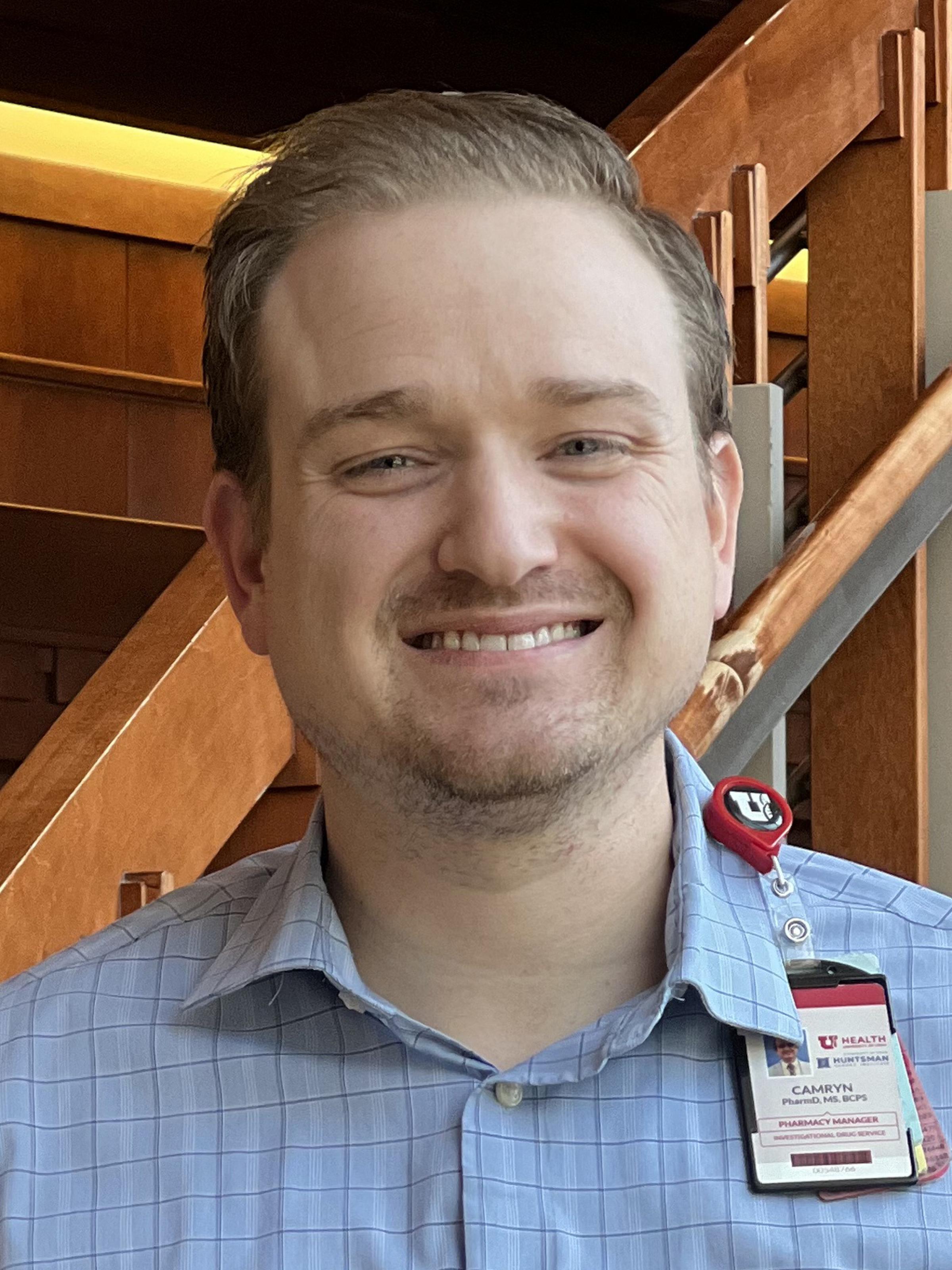
Camryn Froerer, PharmD, MS, BCPS, BCSCP
Manager, Investigational Drug Service
Camryn.Froerer@hci.utah.edu
Bio
Camryn graduated from University of Utah College of Pharmacy in 2018. He then completed a PGY1/PG2 and M.S. degree in Health-System Pharmacy Administration and Leadership at University of Utah Health. After residency he spent time as an Operations Manager at University of Iowa Health Care before rejoining the U of U Health team again in 2021 as the Investigational Drug Services Manager. Outside of his role as RPC, Camryn has offered elective experiences for the HSPAL residents within IDS, acted as project preceptor, and mentored many residents in career decisions along the way.
When Camryn is not at work he enjoys disc golf, spending time with his wife and two kids, and enjoying all that Utah has to offer.